Random header image... Refresh for more!
                       The Wendt Modern of Manhattan, Laguna Beach, Singapore and Vienna represents Juanita Guccione


Work featured in Skidmore review

Nine drawings by Juanita Guccione of the Ouled Nail tribe of eastern Algeria are featured in the spring issue of CELAAN, a review of the Center for the Studies of the Literature and Arts of North Africa at Skidmore College, Saratoga Spring, New York.

The Game, charcoal, circa 1933

The Game, charcoal, circa 1933

The charcoal and pencil drawings, made in the early 1930s while the artist lived among the tribe in and around Bou Saada, are accompanied by a revealing  bio- graphical essay. Some of them were exhibited in 1935-36 at The Brooklyn Museum.

The drawings are among 174 oil and watercolor paintings and drawings owned by Sonatrach, the Algerian national oil and gas company. Algeria’s minister of energy and mines, Dr. Chakib Khelil, is personally supervising the plan to exhibit the work at Sonatrach’s headquarters in the Hydra district of Algiers. The work was shown at The Washington Arts Club in 2004 under the sponsorship of the then Algerian ambassador to the United States, Idriss Jazairy.

CELAAN is edited by Hédi Abdel-Jaouad.

April 10, 2010   No Comments

“To my darling Nita”

Sisters side by side

Sisters side by side

The gouache by Irene Rice Pereira at the left is inscribed at the bottom in Pereira’s hand to “My darling Nita.” Dated 1965, six years before her death, Nita refers to Juanita (Rice) Guccione whose oil painting, Shapeshifter, dated circa 1939, appears at the right. Both paintings are exhibited at the Wendt Modern in the Fuller Building in Manhattan in a non-objective art survey.

Pereira was the older of three Rice sisters. She and Guccione (née Anita Rice) followed their younger sister, Dorothy, into art school. Dorothy died in  her early thirties. The figurative gouaches by Pereira were an essential aspect of her aesthetic discipline. She would rise before dawn each day and execute these large drawings with her eyes closed in a meditative state. It was the artist’s way of preparing for her day’s work in her studio at 121 West 15th Street in Chelsea, the studio where she painted her most important works. Across town Guccione would be painting at 209 and 215 East 19th Street. Guccione, however, also had several studios in both the West and East Villages before her 19th Street tenure.—DM

February 8, 2010   No Comments

Guccione and sister in Wendt show

Paintings by Juanita (Rice) Guccione and her older sister, Irene Rice Pereira, are featured in an exhibition entitled Non-Objective or Not: Dialogues in Modernism at the new Wendt Gallery on the 8th floor of the Fuller Building in Manhattan. The exhibition opens Friday, February 5, and continues through March 13. The survey show is curated by Steven Lowy.

This inaugural show features the artists Rolph Scarlett, Hilla Rebay, Seymour Fogel, Xanti Schawinsky and includes works by Victor Matthews, Gary Stephan, Mary Ann Strandell and Daniel Villeneuve.

Hilla Rebay was an early Pereira champion.

The sisters both studied with Hans Hofmann in Manhattan and in Provincetown, Massachusetts. Pereira is known internationally for her Geometric Abstract paintings. Guccione, who also painted under the names Rice and Marbrook, made a number of important Cubist paintings before settling into her more familiar Figurative Surrealist and Abstract Surrealist oeuvre.

February 5, 2010   No Comments

Newly cleaned paintings

Revelations_sm

Two paintings representative of Juanita Guccione’s major mature oeuvre styles—Conversation By Lamplight and the larger Revelations (above)—have been painstakingly cleaned by the Manhattan conservator Roxanna Lehmann-Haupt.

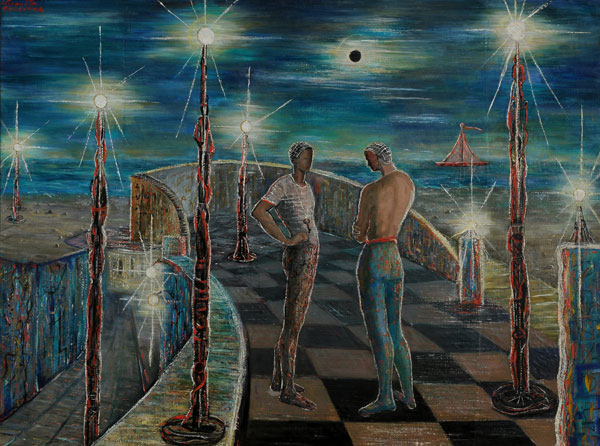
Conversation, a 40 x 30 oil, 1953, is an example of Guccione’s mid-career figurative Surrealist period. Revelations, a 56 1/4 x 42,  1976, acrylic canvas, is characteristic of her later Abstract Surrealist work.

Guccione’s major mid-career influences are likely to have been  Picasso, Giorgio de Chirico, Yves Tanguy and Joan Miro, among others.

She studied with Hans Hofmann on and off during this period, having begun her studies with him while still executing Cubist paintings in the late 1930s. Hofmann was unfailingly enthusiastic about her work, although he never saw the later Abstract Surrealist work.

It was also during this period that she befriended Arshile Gorky. They had nearby studios on the east side of Union Square just north of S. Klein, the hurly-burly discounter. Guccione was deeply influenced by Gorky, who was drawn to both the artist and her work. But his strong influence appears in her work only later in her career in her Abstract Surrealist period, in such paintings as Harbor of Alchemy and Blue Harbor.

Even before his friend Willem de Kooning became his champion, Guccione, then painting as Juanita Rice Marbrook, was telling friends that Gorky was the greatest painter in America. Strange as it is to believe now, it was it was a hard sell at the time.

The French-speaking Guccione was intensely involved with French Surrealist expatriates during the war in Manhattan, often making drawings for their newspaper, Pour La Victoire. But she was more drawn to Spanish Surrealism, finding many of the French Surrealists a bit too literary for her taste.—DM

November 19, 2009   No Comments

Guccione at ArtHamptons

Portico booth at ArtHamptons
A number of oils, acrylics and drawings (above) by Juanita Guccione were exhibited by Portico of Manhattan at the ArtHamptons international art fair, July 12-12. The selections represented the entire range of her life’s work, dating from the mid-1930s to the early 1970s. The exhibit was curated by Steven Lowy of Portico.

August 2, 2009   No Comments